
Stjepan Radić was born in the village of Desno Trebarjevo near Sisak in 1871, as the ninth of eleven children, in the family of poor peasants Imbra and Ana. From birth, he suffered from excessive myopia, which worsened over the years, and in his later years he was almost blind.

He was arrested for the first time at the age of 18, at the beginning of May 1889 in Zagreb, because at the performance of the opera Nikola Šubić Zrinski in the theater, standing on the ground floor, he shouted twice: “Glory to Zrinjski, down the tyrant Héderváry”. He was sentenced to three days in prison, but his stay in prison had no effect on his education and he was allowed to continue his education and finished the sixth grade of high school. During the school summer holidays, young Radić went to Russia. Upon his return, he was put under police surveillance “as a Russian military spy”. , and at the beginning of the new school year he was expelled from school as “politically suspect”. In April 1890, he was arrested again and taken to the hospital for observation, where he was kept for several days and escorted “under police escort” to his native Trebarjevo. After almost a year days spent in his native village, in the fall of 1890, he returned to Zagreb and prepared for the maturity exam. In 1891, he enrolled at the Faculty of Law in Zagreb, but was expelled in 1893 for a public attack on Ban Khuen Hedervary and sentenced to four months strict prison. There is no information on how long he was in detention, and after that he went to Prague where he continues his studies. He was in Prague until the beginning of the court process, and on October 13, 1893, the main hearing was held. He served the full term of his sentence. At the end of 1894, on a trip, he met his future wife, Maria Dvořák, a Czech, a teacher’s school graduate whom he married in Prague in 1898. They had four children, Milica (1899 – 1946), Miroslava (Mira) (1901 – 1988), Vladimir (Vlatko) (1906 – 1970) and Branislav (Branimir, Branka) (1912 – 1983). ). He was soon expelled from the University of Prague, and immediately afterwards from the University of Pest, so that further studies were impossible for him in the entire territory of the Austro-Hungarian Monarchy.

In 1896, he traveled to Russia again, where he stayed for about five months. In the period between 1897 and 1899, he studied, intermittently, at the Free School of Political Sciences (École libre des sciences politiques) in Paris. He went to Paris at the end of January 1897, but he did not enroll at the Political School until the autumn of the same year, since he did not have enough money to pay the school fees. He spent some time, the holidays in 1897, in Switzerland, improving his French language and studying the political conditions there. He finished his first year in 1898 with the basic subjects of diplomatic history, comparative civil law, ethnography and finance. He went to Paris for the second time at the beginning of February 1899 and, living with his wife in poverty, he finished his academic education in five months and, in addition, wrote a treatise for his diploma, “Modern Croatia and the Southern Slavs” (“La Croatie actuelle et les Slaves du Sud”). During the day, he attended lectures, and in the evening, until late at night, he dictated the discussion in French to his wife Maria. He finished his studies as the second in his generation and as a reward he received from the school an entire library of 60 books in the field of political science. Then he lived for some time in Prague, collaborating with Czech newspapers, and when the police expelled him from Prague, he went to Zemun, in the summer of 1900, as a Balkan correspondent for Czech, French and Russian newspapers. There he establishes connections with prominent Serbian politicians and publishes articles in the „Serbian Literary Gazette“. In 1901, he started and edited the weekly „Živa Domovina in Zemun“. Since 1902, he has been living in Zagreb and working as the secretary of the Croatian United Opposition.
From 1902 until 1906, he was the chief editor of the monthly „Hrvatska misao“. Together with his brother Antun, Benjamin Šuperin, Svetimir Korporić, Milan Krištof and Ivan Gmajner, he founded a political party, HPSS (Croatian People’s Peasant Party), at the end of 1904. When organizing the Peasants’ Party, Radić wrote that he had to fight: “only with constitutional means, respectively, if there are no constitutional means, only with the written and living word, with a manly and courageous word, until necessary and regardless of the consequences. It is good to fight both with actions and with plow and hoe, association and public meeting, collective petitions and protests, but never under any pretext and for any purpose with whatever material weapon he pleases, be it stone or bomb, club or rifle, stake or axe.”
In 1905, at the first main annual meeting of the HPSS in Zagreb, Stjepan Radić was unanimously elected as the party’s president. In the elections for the Croatian State Parliament in 1906, the HPSS experienced failure, but already in 1911 it won eight mandates.

After the end of the First World War and the disintegration of Austria-Hungary, it was agreed to establish the National Council. At the founding meeting of the National Council of Slovenes, Croats and Serbs in Zagreb, on October 5, 1918, the HPSS also announced its accession, and later Stjepan Radić became a member of the Central Committee of the National Council of the SHS. Feeling for any Croatian peasant, Radić increasingly insists on the preservation of the Croatian state. In the National Council, the view that the unification of the State of SHS with Serbia and Montenegro should be carried out as soon as possible and on a unitary basis, without any clarifications about the position of individual historical countries that would join the common state, was increasingly prevalent, and Radić, at the session of the Central Committee of the National council on November 23, 1918 submitted a proposal to organize the common state as a federal state in which the supreme power would be held by three regents, the Serbian heir to the throne, the Croatian ban and the president of the Slovenian People’s Council. The next day, November 24, 1918, at another session of the Central Committee of the National Council of the SHS, he gave a speech opposing the centralist-hegemonic way of unifying the South Slavic countries. Radić then issued a prophetic admonition: “Gentlemen! It’s not too late! Don’t rush like geese into the fog.”
Radić was elected to the 28-member delegation that went to Belgrade for the declaration of unification, but the main assembly of the HPSS, which was held on November 25, 1918, concluded that he would not go to Belgrade. Commenting on that decision, he said: “Whatever happens, don’t hate Serbians. Our sister Serbia is being declared as our mother. Our mother is only our holy homeland.” The next day, November 26, 1918, the Central Committee of the People’s Council excluded him, but not his party HPSS, from the Council “due to his attacks and slanders” at that party’s general assembly where he called “our gentlemen” who lead politics ” infatuated”, “vain”, “violent”, “selfish”.

At the end of 1918, he was already openly emphasizing his republicanism, and in 1919 he convened an extraordinary general assembly of the HPSS, from which public accusations were sent to the regime, and the Central Committee of the HPSS demanded a Croatian neutral peasant republic, and it was decided to address this request to American President Woodrow Wilson.
Even in the new state, Radić was subjected to strict supervision by the administrative authorities, the gendarmerie, the police and the army, and he was persecuted, punished, tried and imprisoned. In February 1919, he addressed the Peace Conference in Paris with a memorandum in which he demanded the right to self-determination for the Croatian people and expressed his wish that Croatia of its own free will join an equal federal union with Serbia and Montenegro.
From March 1919 to November 1920, he was again in prison or under investigation. Stjepan Radić was arrested for the first time in the new state on March 25, 1919, on a direct order from Belgrade, and Marija Radić and their daughter Mira were also arrested during September and held in prison for about fifteen days in order to exert pressure on Radić. At that time, the champions of the Croatian Party of Rights, Dr. Josip Pazman and Dr. Vladimir Prebeg, and former MP Dragutin Hrvoj were also arrested. It was one of the first moves by the Karađorđević authorities to disable the opposition in the new state. Radić was arrested even though he had immunity from inviolability as a people’s representative. At first, Stjepan Radić was in solitary confinement for about two months and often suffered various forms of mistreatment and abuse. He remained in custody the longest of all those arrested and was released on February 27th following the intervention of the new Croatian Ban Matko Laginja, against the will of the regent Aleksandar Karađorđević, the Belgrade government and Svetozar Pribićević. In 1920, his party changed its name to HRSS (Croatian Republican Peasant Party). In the 1920s, Radić and his party were in sharp opposition to the regime.
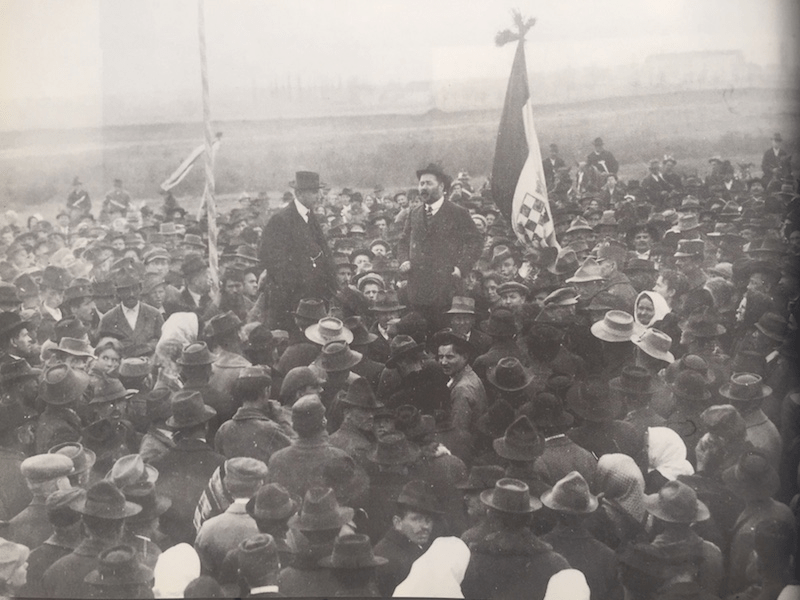
On November 28, 1920, in the elections for the Constituent Assembly, the HRSS received 230,590 votes, or 50 seats, thus becoming the largest Croatian political party. In July 1923, Radić traveled to London, Vienna and then to Moscow, where he joined his party in the Peasants’ International. Because of this, the party was declared communist and upon his return to Zagreb in January 1925, Radić was arrested and brought to court. He was released only after his party (March 27, 1925) made a statement in the Belgrade National Assembly that it recognized the monarchy, the centralist Vidovdan Constitution, the existing state order, and after HRSS changed its name to HSS (Croatian Peasant Party). Already in November (due to the new orientation), Radić enters the tenth government of Prime Minister Nikola Pašić as Minister of Education.
In February 1927, Radić was again in the opposition and formed a coalition with Svetozar Pribičević’s Independent Democratic Party (SDS), and on November 10, 1927, the Peasant-Democratic Coalition (SDK) was formed. The main goals of the coalition were: the reorganization of Yugoslav political life, the end of non-parliamentary procedures and the fight against Greater Serbian hegemony. SDK was headed by two presidents, Stjepan Radić and Svetozar Pribićević. A year later, in February 1928, a government crisis opened after the resignation of Velja Vukičević, but the king entrusted him with the mandate to form the new government. Vukičević then offered Radić the entry of HSS representatives into the government, but without Pribićević’s independent democrats, which Radić refused, and Vukičević returned the mandate. After Vukičević’s failure to form a government, the king entrusted the mandate to Radić with the task of forming a broader concentration government, after which Radić immediately agreed to consult with the heads of individual parliamentary groups. Radić also addressed the radical parliamentary club, which announced that they are ready to enter the government only on the condition that the prime minister be a radical, given the fact that the Radical Party has the most representatives in the parliament. Radić then sent a reply in which he questions the validity of the decisions of the radical club, because only 37 representatives attended the session and demanded from Vukičević to convene the full club, but Vukičević refused and Radić returned the mandate.

During 1928, Radić began receiving more and more death threats, as well as his associates and the leader of the Independent Democratic Party, Svetozar Pribićević. Death threats are published in the Belgrade regime press (for example, in „Jedinstvo“, close to Prime Minister Velja Vukičević, several times) with the explanation that they are working against the foundations of the state. „Politika“ published an introductory article at the end of which it was written that one could easily find a citizen ready to settle scores with Radić if the state does not do it, and „Samouprava“, which was the main organ of the strongest Serbian political party, wrote in the same article on several occasions meaning. At that time, during the sitting of the National Assembly, certain radical representatives also threatened the death of Radić, Pribićević and their associates, but neither the leadership of the National Assembly nor other factors did anything to investigate or prevent these threats and the seriousness of the expressed intentions. On June 20, 1928, with revolver shots, court agent, member of the Radical Party Puniša Račić wounded Ivan Pernar and Ivan Granđa, mortally wounded Stjepan Radić and killed Đuro Basariček and Pavle Radić, representatives of the HSS. Dr. Ivan Pernar was hit by two bullets. Račić’s first bullet hits him in the hand, and the second less than a centimeter below the heart, three millimeters below the pulse vein, after which he falls under the bench, thus avoiding the third bullet intended for him. Pernar carried that second revolver bullet in his body for the rest of his life. Ivan Granđa, a peasant, a representative from the village of Šašinovac, was sitting on the bench next to Stjepan Radić and was wounded in the left hand when, at the moment of the assassination, he protected Stjepan Radić with his body and thus saved him from imminent death. The assassination of the people’s representatives in the Belgrade assembly was experienced in Croatia as an attack on the entire Croatian people, and protests followed throughout Croatia, with around 100,000 demonstrators in Zagreb. Gendarmerie and police killed three, wounded 60 and arrested 120 protesters.
After the assassination, Radić was transferred to a Belgrade hospital where he underwent emergency surgery. He stayed in the Belgrade hospital until July 8, 1928, from where, after a slight improvement in his health, he was transferred to Zagreb, where he continued his treatment. Representatives of the Peasant-Democratic Coalition left Belgrade and did not participate in the work of the National Assembly that met on August 1, 1928. They gathered in Zagreb, in the building of the Croatian Parliament, for a plenary session presided over by Vladko Maček and opened by Svetozar Pribićević. Then a resolution was accepted, which states the goal of the Peasant-Democratic Coalition to use a legal struggle in parliament to win changes to the system in the country in order to achieve equality and equality of Croatia and all neighboring countries with Serbia, emphasizing how the system of hegemony used organized crime to prevent the success of the legal struggle Peasant-democratic coalitions.

Stjepan Radić died as a result of his injuries in his house in Hercegovačka cesta 4 on August 8, 1928. His body was placed on a bier in the Croatian Peasants’ Home in Zagreb, where he stayed for four days so that the people could pay him their last respects. He was buried on August 12, 1928, in Zagreb, at the Mirogoj cemetery. About 300,000 people gathered at his last farewell.
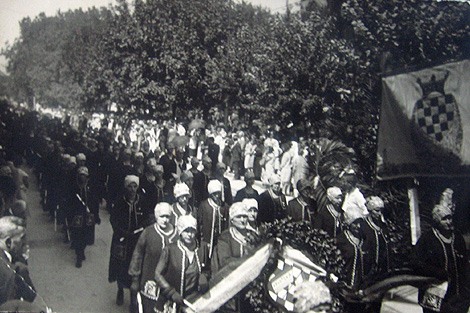
During his lifetime, Stjepan Radić became one of the most respected and popular figures on the Croatian political scene in the first three decades of the 20th century, which was greatly contributed to by his communicative and oratorical skills, consistent representation of Croatian national interests, and progressive, often idealistic ideas. Due to his attachment to the Croatian peasantry, from which he himself came, he found the almost unanimous support of the people in all Croatian regions. In the fight for his goals, he faced political persecution, pressure, harassment and prison sentences. Precisely because of his uncompromising position in the implementation of democratic and republican ideas, his life ended violently at a time when the spread of totalitarian ideas affected a large part of Europe, as well as the Kingdom of Yugoslavia.
 HISTORY OF CROATIA and related history
Hi there.I
LikeLike