
Ancient Roman sources refer to the early Slavic peoples as the Veneti, who lived in the region of central Europe east of the Germanic Suebi tribe and west of the Iranian Sarmatians in the 1st and 2nd centuries AD between the upper Vistula and Dnieper rivers, in what is now Poland, Ukraine and Belarus. The Slavs under the name Anti and Sclaveni first appear in Byzantine records at the beginning of the 6th century. Byzantine historiographers during the time of Emperor Justinian I (527 – 565) describe these tribes appearing from the area of the Carpathians, the lower Danube and the Black Sea, penetrating into the Byzantine Danubian provinces.
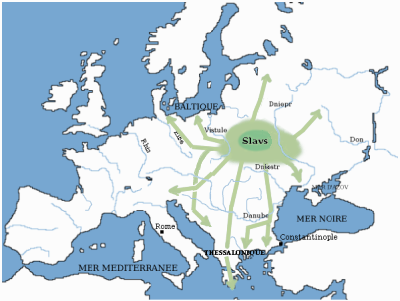
Jordanes, in his work “Getica” (written in 551), describes the Veneti as “a populous nation” whose settlements begin at the headwaters of the Vistula and occupy “a large expanse of land”. He also describes the Veneti as the ancestors of the Ants and Slavs, two later Slavic tribes. Procopius wrote in 545 that “Sclaveni and Anti actually had the same name in the ancient past; for both were called Sporoi in ancient times”. The name Sporoi comes from the Greek σπείρω (“to sow”). He described them as barbarians, who lived in a democracy, believed in one god, the “creator of lightning” (Perun), to whom they offered sacrifices. They lived scattered and constantly changed settlements. In war, they were mostly foot soldiers with shields, spears, bows and small armour, which was reserved mainly for the chiefs and their inner circle of warriors. Their language is “barbarian” (not Greek), and the two tribes are similar in appearance, tall and strong, “while their bodies and hair are neither very fair nor blue. Yet they do not even belong to the dark-skinned people… They live a hard life, disregarding bodily comforts…” Jordanes described the Sclavene as having swamps and forests for their cities. Another source from the 6th century mentions them living among almost impassable forests, rivers, lakes and swamps.
The oldest toponyms with a Croatian name appear in the area of Western Ukraine and Southern Poland north of the Carpathians. This area was inhabited by White Croats (Northern Croats) who later began to descend south to the Balkan Peninsula.
In the 6th century, large migrations of Slavs to the Balkan Peninsula began. The name of the Croats is associated with the last wave of migration at the turn of the VI. in VII. century. Croatian and Avar tribes inhabit today’s areas of Croatia (then the Roman provinces of Dalmatia and Pannonia). The old, Roman population retreated towards the Adriatic coast and to the islands, and over time it assimilated and only some towns retained the Roman character.

The arrival of Croats in today’s area should not be seen as a specific event with a clear beginning and end, but also as a mass migration. These are lengthy processes. Also, today’s science believes that the Slavs during the 7th and 8th centuries in this area still lived organized in smaller groups without the desire and need for unification, mixed with the natives. The influence of the supreme Avar authority was probably weak. The Avar center was far to the north, in the area of present-day Hungary. Neither the Avars nor the Byzantines could, and perhaps did not want to, unite the Slavic tribes under some central authority. The first signs of the development of a central government appear at the beginning of IX. century during the wars of Charlemagne against the Avars. In 796, Frankish sources mention the Slavic leader Vojnomir from Istria as a Frankish ally. Slavic groups under Frankish influence seek to be united to fight the Avars and Byzantines more effectively.
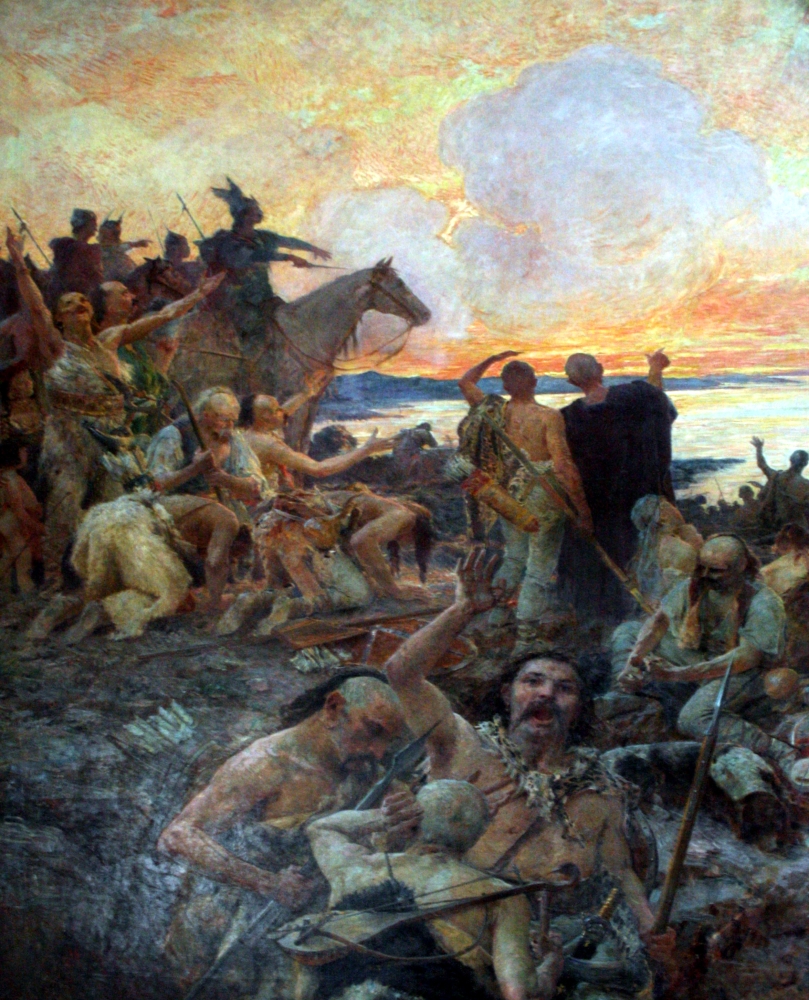
It could be inferred that the Croats were initially called members of the military elite who, after taking control of the local population with the help of the Franks, gradually imposed their name as an ethnopolitical term. The Croatian name starts to appear in the sources in the middle of 9th century in the hinterland of Dalmatian cities. From this core, Croatian identity will slowly expand to the north in the following centuries. The penetration of the influence of the Croatian ruler into Pannonia began at the latest from the time of King Tomislav, and the complete administrative and ethnopolitical connection between Dalmatia and Pannonia would occur only in the period after the time of the Croatian kings.
https://shareasale.com/r.cfm?b=1535860&u=2715654&m=96940&urllink=&afftrack=

 HISTORY OF CROATIA and related history
California usa always everything about chumash people and i am a nature person paddle boat fishing, coast life, so i want to see how dalmatian island people dressed, the tools, hunting methods, shelter homes, etc.
LikeLike
This is an interesting overview of Slavic history.
LikeLiked by 2 people