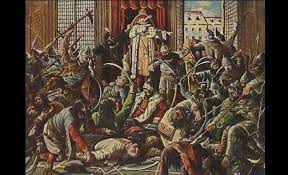
In the Middle Ages, the county of Križevci was the largest county in Northern Croatia. It had exceptional social and political significance, especially the town of Križevci itself, where sabors (assemblies) were held, the most famous of which was the “Bloody Sabor” or the „Bloody Assembly“.
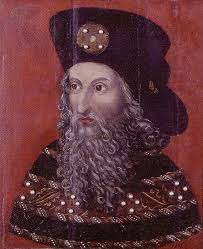
A large Christian and Turkish armies clashed at the end of September 1396 in the bloody battle of Nikopolis. The bulk of the Christian forces was led by the Hungarian-Croatian king Sigismund of Luxembourg, one wing of the army by Herman of Celje, and the other by the Croatian ban Stjepan II Lacković. The Turks won a great victory with heavy losses on both sides. The king was saved from certain death at the last moment by his loyal friend Herman of Celje. They boarded the Venetian galleys that were anchored along the banks of the Danube and headed back to Croatia and Hungary through the Black and Aegean seas. The Croatian people were already dissatisfied with Sigismund’s injustice and cruelty. After learning about the defeat of the royal army at Nikopolis, at a time when it was not known whether the king was alive, the people demanded that the Neapolitan king Ladislav Anjou take over the crown. This is how the Croatian league led by ban Lacković is created.
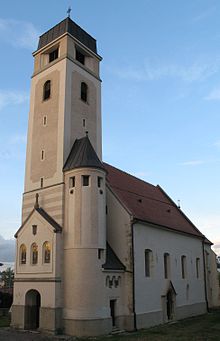
After a long journey back through Dubrovnik and Split, Sigismund returns to the kingdom. Wanting reconciliation with the Croatian nobles, he convenes a sabor (council) in Križevci and guarantees free access to all present. Ban Stjepan II Lacković was also invited. Apparently, the assembly was held in the Church of the Holy Cross. The Croatian army remained encamped outside the city, and ban Lacković, his nephew Andrija and the rest of the arrived Croatian nobles left their weapons in front of the venue because they were told to enjoy the king’s protection. But it seems that during the meeting there was a quarrel between the nobles loyal to Sigismund and those of Lacković. They accused Lacković of running away from the battlefield in the Battle of Nikopolis and thus contributing to the victory of the Turks. A heated argument led to a fight. After that, the nobles loyal to the king drew their swords and cut down Ban Lacković and the rest of the Croatian nobles before the eyes of the king.

It happened on February 27, 1397. Upon hearing the news of the death of the ban and nobles, part of the Croatian army rushed to Križevci. There were more supporters of the king and they easily repulsed the demoralized soldiers.

The enraged Croatian people, under the leadership of Stjepan Prodavić, once again tried to take revenge on the king in Podravina, but they were repulsed again. Sigismund used the opportunity and crossed the Drava river with his subjects on March 2 and retreated to Hungary. Two days later, he issued a famous charter in Žaknje by which he gave the city of Čakovec, Međimurje and other estates of Stjepan Lacković to his loyal subjects, among the first being Herman of Celje. Sigismund tried to wash away his guilty conscience by giving new royal privileges to Križevci as well as to some other cities in Croatia.
There are many reasons for this development of events during the holding of the council. I have mentioned some of them in this text, but what is certain is that Sigismund’s “firm hand” policy managed to remove the opponents of his rule, strengthen his position in the kingdom and sent a harsh message to possible opponents. And all that in one day…
 HISTORY OF CROATIA and related history