
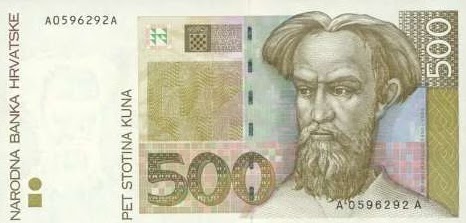
Marko Marulić (lat. Marcus Marulus Spalatensis) (Split, August 18, 1450 – Split, January 5, 1524) was a Croatian writer and Christian humanist, the father of Croatian literature. He is often referred to as an ethnic “Splician”. He left behind a rich and diverse oeuvre, which is characterized by exceptional literary stylization, knowledge and skill, and the ability to adapt to a diverse readership.
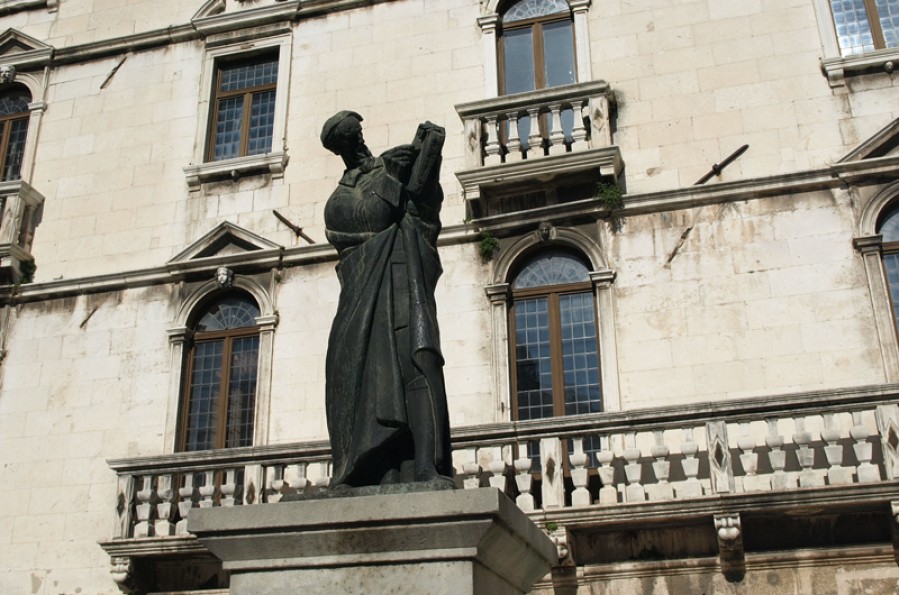
He wrote most of his works in Latin, but he also left important works in Croatian and several short writings in Italian. In his Latin works he signs himself as “Marcus Marulus Spalatensis” or “Marcus Marulus Delmata”, and in Croatian as Marko Pečenić. His literary models were the Bible, ancient literature and patrology. The first use of the word “psychology” in the literature of the Middle Ages is attributed to Marulić in his work “Psichiologia de ratione animae humanae”.
By the decision of the Croatian Parliament from 1996, April 22 is marked as Croatian Book Day in memory of Marko Marulić, who completed the epic Judita on that day in 1501.

Marko Marulić was born in 1450 in the noble family Marulić from Split, which from 1436 was also called Pečenić. The form Marulić is found in Judita. His parents were Nikola Pečenić and Dobrica Obirtić (Alberti). Both his parents were members of distinguished noble families. Marko was the eldest of six sons and two daughters. He graduated the humanities school in Split, but it is not known exactly where he studied, according to some assumptions in Padova. He practiced law in his hometown and performed various city duties: examiner, judge, executor of wills, witness in settlements and contracts, representative in litigation and prosecutor. He is the central person of the Split Humanist Circle.
There were two conflicting opinions about Marulić’s youthful years: on the one hand, Frano Božićević Natalis wrote in Marulić’s biography that he lived a dissolute life in his youth. According to another story, Marulić lived a semi-hermit life from the beginning.
He was active in helping the Croatian dukes against the Ottomans. And the poet’s calls to fight against the Turks radiate Croatian patriotism. Croats are his main representatives of the fight against the Ottomans, so he does not even mention the Hungarians in his poem “Prayer Against the Turks”. He occasionally traveled to Venice and Rome, and spent some time on the island of Šolta.
Marulić is called the father of Croatian literature, a learned poet (poeta doctus), and a Christian poet (poeta christianus). His biography was written by Frano Božičević Natalis, called “Vita Marci Maruli Spalatensis” (“The Life of Mark Marulić of Split”).
Marulić takes over medieval contents, but puts them in new forms, probably under the influence of the movement of lay piety, the so-called „devotio moderna“. Marulić’s connection with the Croatian medieval literary heritage is evident in the echoes of the Glagolitic Paris hymnal in his verses. His language is Split Chakavian with moderate Old Slavisms, Raguseisms and Štokavisms, while Latin reflects the Middle Ages in both vocabulary and style. His works are trilingual, with works in Latin, Croatian and Italian.
He wrote prose and poetic works in Latin and Croatian. As a Christian humanist, he tried to harmonize ancient wisdom and poetics with biblical prophecy and Christian spirituality. In his works, he was inspired by the Bible and hagiography, ancient classics and church fathers, contemporary events and Christian moral principles. He gained European and world fame with his spiritual and moralistic writings in Latin, which in the 16th and 17th centuries saw numerous editions and translations and were among the most widely read spiritual works of that time. They were read by many European dignitaries (St. Francis Xavier, P. Skarga, St. Francis de Sales, T. More, S. Münster, F. de Quevedo, P. Bayle, the English king Henry VIII and others. He is the main representative of religious inspiration among humanists.
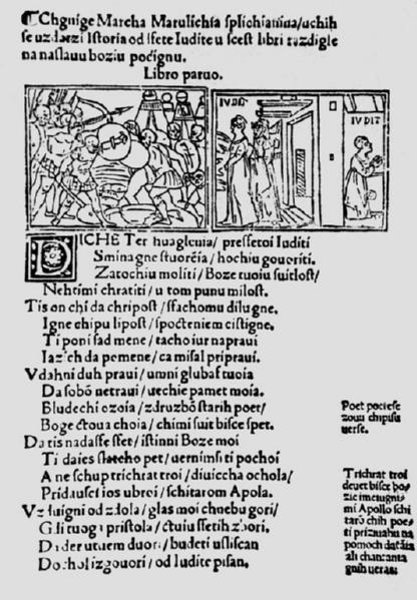
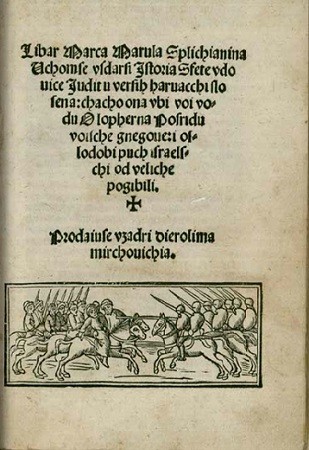
Among the works in the Croatian language, the religious epic “Judita” (written in 1501, published in 1521) should be singled out, in the Croatian language and the Chakavian dialect, inspired by the Old Testament heroine Judith, the events of the time (Ottoman penetration into Croatian lands), and at the same time it is an interpreter of Christian worldview. In Judith, Marulić combines biblical motifs with the motifs of the region in which he lives. Marulić takes the famous verse with which “Judita” was written from the “old poets”, and the way of writing from the old Croatian writers.
Then there is the biblical poem “Suzana” written in 780 verses, which thematizes the biblical story of a Babylonian Jewish woman falsely accused of adultery.
“Prayer against the Turks” is a poem in 172 doubly rhyming twelfths with an anti-Turkish theme, written between 1493 and 1500. In the poem there is a hidden acrostic “Solus Deus potes nos liberare de tribulatione inimicorum Turcorum sua potentia infinita”, “Only God, with his almighty hand , can save us from the trouble of our Turkish enemies”, which was discovered by Luko Paljetak. It is assumed that it was influenced by Juraj Šižgorić with his “Elegy on the Devastation of the Šibenik Field” and the medieval poem “Save, Mary, your faithful ones“ from the Tkonsko zbornik. With this work, Marulić influenced the Croatian writers of the later period, Petar Zoranić, Petar Lučić and Primož Trubar…
“Indictment of the City of Jerusalem” is also a work with an anti-Turkish theme, as well as numerous other poems, poetry and dramatic texts…
The most famous of the parts in Latin is “Davidias”, a religious heroic-historical epic in 14 books with 6765 hexameters. The epic was written according to Virgil’s model in classical Latin, with some admixtures of biblical and medieval Latinity, and possesses considerable artistic qualities. The work combines biblical (the story of King David) and ancient motifs, but with a distinctly Christian tendency, whereby the entire work is an allegory: David is Christ, and Saul is the Jew, and at the end of the work there is a key to discover the analogy, Tropologica Davidias expositio.
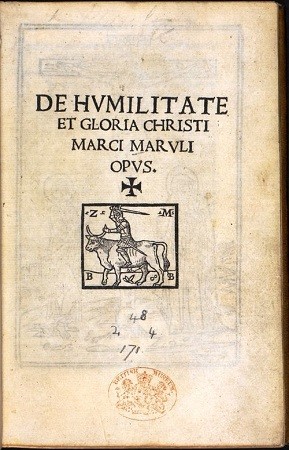
Then “De humilitate et gloria Christi” (“On the humility and glory of Christ”), a Christological treatise from 1518 in which he proves to the Jews that Christ is the promised Messiah.
“De institutione bene vivendi per exempla sanctorum” (“Lessons for a virtuous life according to the examples of the saints”) is a moralistic work of biblical and hagiographic inspiration, a collection of instructive stories and anecdotes, a religious, moral and instructive work in six books from 1498. It is his most translated work in the world, which was even translated into Japanese during his lifetime, and was printed about sixty times (four times during his lifetime).
“Dialogus de Hercule a Christocolis superato” (“Dialogue about Hercules who was surpassed by the worshipers of Christ”), a dialogue that was created around 1519 and was printed in 1524. In the dialogue, the Poet and Theologian discuss the use of mythology (Heracles) and allegory in poetry.
“Epistola Marci Maruli Spalatensis ad Adrianum VI.” (“Letter of Marko Marulić of Split to Hadrian VI”) is a letter to Pope Hadrian VI as an appeal for the establishment of harmony among the Cristian rulers to resist the Turks together.
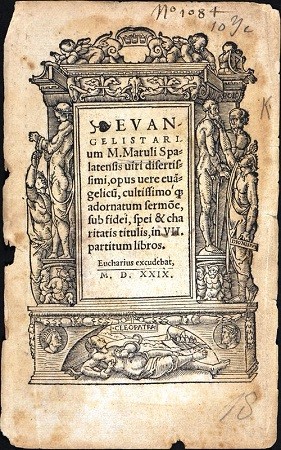
“Evangelistarium” (“Evangelist”) is a systematic moralistic treatise in seven books, created in the period from 1480 to 1500, printed about sixty times. The work talks about the ethical principles and moral duties expected of a Christian, and is based on three virtues: faith, hope and love.
The list of written works by Marko Maručić in Latin is still extremely large, and many of them have exceptional artistic value.
Marko Marulić died in Split in 1524, and was buried in church of St. Frane.
 HISTORY OF CROATIA and related history
One thought on “Marko Marulić (1450 – 1524), writer”